Space Heater Electrical Safety: What NC Homeowners Should Know
Space heaters are one of the leading causes of home fires in the United States. According to the National Fire Protection Association (NFPA), space heaters account for 43% of home heating fires and 85% of home heating fire deaths — despite being used in a small percentage of homes. Many of these fires have an electrical cause that could have been prevented.
Here's what every Winston-Salem homeowner should know about space heater electrical safety.
How Much Power Does a Space Heater Draw?
A typical portable electric space heater draws 1,500 watts at its highest setting. On a standard 120V household circuit, that's about 12.5 amps — nearly the full capacity of a 15-amp circuit.
This is the critical number to understand: a 15-amp circuit can safely handle 1,440 watts continuously (80% of its 1,800-watt capacity, per code). A single 1,500-watt space heater uses virtually all of that capacity. Plug in anything else on the same circuit — a lamp, a TV, a phone charger — and you're over the safe limit. The breaker trips.
If the breaker doesn't trip (due to age, defect, or being a Federal Pacific or Zinsco breaker), the wiring overheats — and that's how fires start inside walls.
Why Space Heaters Trip Breakers — and What It Means for Your Wiring
If your breaker trips every time you turn on a space heater, your breaker is doing its job. It's protecting your wiring from overheating. Don't ignore this warning.
Common causes of space heater breaker trips:
- The circuit is already loaded: Other devices on the same circuit (lights, TV, computer) are using part of the circuit's capacity. Adding a 1,500-watt heater pushes it over.
- The breaker is old or weak: Breakers weaken over time. An older breaker that used to hold 15 amps may now trip at 12 amps.
- The wiring is undersized: If someone installed a 20-amp breaker on 14-gauge wire (rated for 15 amps), the wire will overheat before the breaker trips. This is a fire hazard.
- Loose connections: Loose wire connections at outlets or the panel create resistance and heat, which can cause breakers to trip.
Safe vs. Unsafe Extension Cord Use with Space Heaters
Never use a space heater with an extension cord — ever.
This is the single most important space heater safety rule. Here's why:
- Most household extension cords are rated for 10–13 amps. A space heater draws 12.5 amps — right at or over the cord's limit.
- The cord will heat up — potentially melting the insulation and starting a fire.
- Lightweight cords (16-gauge or 18-gauge, the kind most people have in their garage) are especially dangerous with high-draw devices.
If you must use an extension cord with a space heater (and you really shouldn't), the only acceptable option is a 12-gauge or heavier outdoor-rated cord rated for at least 15 amps — and even then, it's not recommended for continuous use.
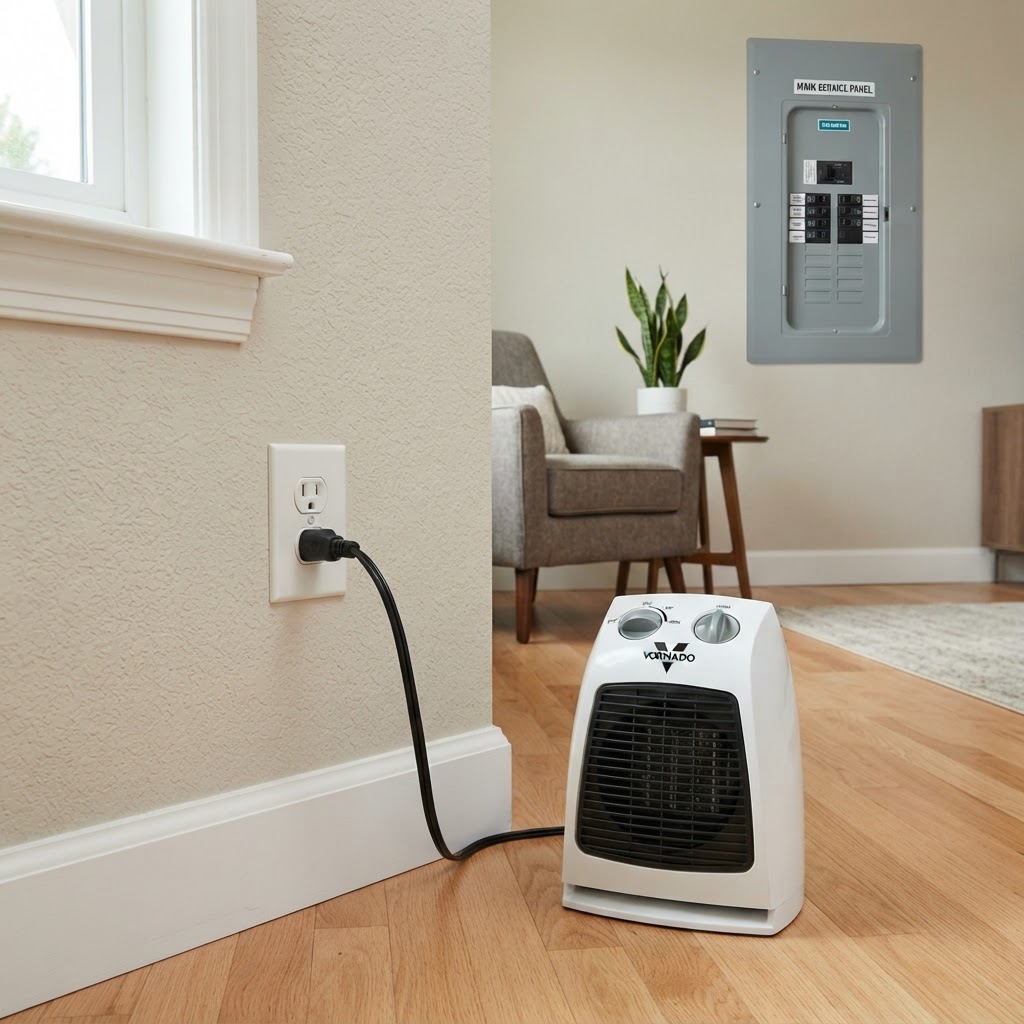
The right solution: Plug the space heater directly into a wall outlet. If the outlet is too far away, have a new outlet installed where you need it. Adding an outlet costs $150–$350 — far less than the cost of a house fire.
When a Dedicated Circuit Makes Sense for Supplemental Heating
If you regularly use a space heater in the same location — a finished basement, a home office, a drafty bedroom — consider having a dedicated circuit installed. A dedicated 20-amp circuit with 12-gauge wiring can safely power a space heater without risk of overloading other circuits.
Cost: $200–$500 for a dedicated circuit, depending on distance from the panel and wall accessibility.
This is also recommended if you use a window AC unit in the summer and a space heater in the winter in the same room — both are high-draw devices that benefit from a dedicated circuit.
NFPA Statistics: Space Heater Fires and How to Prevent Them
According to NFPA data:
- Space heaters cause an average of 43% of home heating fires
- They account for 85% of home heating fire deaths
- The leading factor in space heater fires is placing the heater too close to combustible materials (curtains, bedding, furniture)
- Extension cord failure is a leading cause of space heater electrical fires
Space Heater Safety Checklist
- ✅ Plug space heaters directly into a wall outlet — never an extension cord or power strip
- ✅ Keep heaters at least 3 feet from curtains, bedding, furniture, and anything flammable
- ✅ Never leave a space heater running unattended or while sleeping
- ✅ Never use a space heater with a damaged cord or plug
- ✅ Place heaters on a flat, level surface — never on carpets that can overheat
- ✅ Choose heaters with tip-over and overheat protection (auto shut-off)
- ✅ Don't plug anything else into the same outlet as the heater
- ✅ If breakers trip when you use the heater, call an electrician — don't keep resetting
Schedule a Free Safety Inspection
If you rely on space heaters for supplemental heating and your breakers are tripping, your home may need additional circuits or a panel assessment. Dausman Electric offers free safety inspections for new customers throughout Winston-Salem, Forsyth County, and the Triad.
Call (336) 978-7844 or schedule online.
See also: Circuit Breaker Tripping Guide | Panel Upgrade Guide | Holiday Lighting Safety