Holiday Lighting Safety Guide for Winston-Salem Homeowners (2026)
Holiday lighting transforms Winston-Salem homes into festive displays — but it also creates one of the most common seasonal electrical hazards. Every November and December, overloaded circuits, improper extension cord use, and faulty outdoor lighting cause fires, electrical shocks, and property damage that could have been prevented.
Here's what every Winston-Salem homeowner should know before stringing up their holiday lights.
How Many Strands of Lights Can You Safely Run on One Circuit?
This is the most common question — and the answer surprises most people. A standard 15-amp household circuit can safely handle about 1,440 watts of continuous load (80% of the circuit's 1,800-watt capacity, per code).
LED holiday lights: A typical 25-foot LED string uses about 2–4 watts. You can safely connect 20+ strands end-to-end on a single circuit — LED lights make overloading very difficult.
Incandescent holiday lights: A typical 25-foot incandescent string uses about 40 watts. The manufacturer's recommendation (usually printed on the box or tag) limits end-to-end connections to 3–5 strands. Connecting more risks overloading the wire itself, even if the circuit can handle the total wattage.
Rule of thumb: Switch to LED holiday lights. They use 80–90% less electricity, generate almost no heat (reducing fire risk), last longer, and allow you to connect many more strands without overloading anything.
Indoor vs. Outdoor-Rated Lighting: Why It Matters
Holiday lights are rated for specific environments. Using indoor-rated lights outdoors — or vice versa — creates hazards:
Indoor lights used outdoors: Indoor lights aren't sealed against moisture. Rain and humidity can cause short circuits, shock hazards, and corrosion of the wire connections. Only use lights clearly marked "Suitable for Wet Locations" or "Outdoor Use" outdoors.
Outdoor lights used indoors: Generally safe, but some outdoor lights generate more heat than indoor lights. Check the manufacturer's recommendations.
Check the labeling: Every string of holiday lights should have a UL (Underwriters Laboratories) tag. Look for:
- Red UL holographic label = Suitable for wet locations (outdoor use)
- Green UL holographic label = Indoor use only
Extension Cord Safety for Holiday Displays
Extension cords are involved in thousands of holiday fires every year. Follow these rules:
- Use outdoor-rated cords outdoors. Indoor extension cords aren't sealed against moisture and will degrade in wet conditions, creating short circuits and shock hazards.
- Never run cords under rugs, carpets, or through doorways. The cord can overheat without any visible warning.
- Never daisy-chain power strips. Plugging one power strip into another overloads the connection and is a fire hazard.
- Use the right gauge. For outdoor holiday lighting, use at least 16-gauge extension cords. For longer runs or higher-wattage displays, use 14-gauge or 12-gauge.
- Check for damage before use. Discard any cord with cracked insulation, exposed wires, or loose plugs.
- Don't overload a single cord. Check the cord's wattage rating (usually printed on the packaging) and stay within it.
GFCI Protection for Outdoor Holiday Lighting
All outdoor electrical outlets must have GFCI (Ground Fault Circuit Interrupter) protection — this is required by NC electrical code and is critical for holiday lighting safety. GFCI outlets cut power within milliseconds if they detect current leaking through an unintended path (like water or a person).
Test your outdoor GFCI outlets before plugging in holiday lights:
- Plug a light or device into the outlet.
- Press the TEST button — the light should turn off.
- Press RESET — the light should turn back on.
- If the outlet fails either test, replace it before using it for holiday lighting.
If your outdoor outlets don't have GFCI protection (common in homes built before 1990), have them upgraded before the holiday season. Dausman Electric installs weatherproof GFCI outlets throughout Winston-Salem — typically $150–$300 per outlet.
Weatherproof In-Use Covers
NC code requires outdoor outlets to have weatherproof "in-use" covers — covers that seal even when a plug is inserted, not just when the outlet is empty. If your outdoor outlets have flip-up covers that only protect when nothing is plugged in, they're not code-compliant for holiday lighting use. Replace them with in-use covers before the holidays.
Signs Your Home Needs Electrical Work Before the Holidays
Before you plug in your holiday display, watch for these warning signs:
- Breakers trip when you plug in holiday lights — your circuits may be overloaded
- Outdoor outlets are cracked, missing covers, or lack GFCI protection
- Lights dim when you plug in your display — your panel may be undersized
- You're using multiple extension cords and power strips to reach outdoor areas — you need more outdoor outlets
- Your home has two-prong ungrounded outlets and you're using three-prong adapters
- You smell burning plastic or ozone near outlets or extension cords — stop using them immediately and call an electrician
Adding Outdoor Outlets for Holiday Lighting
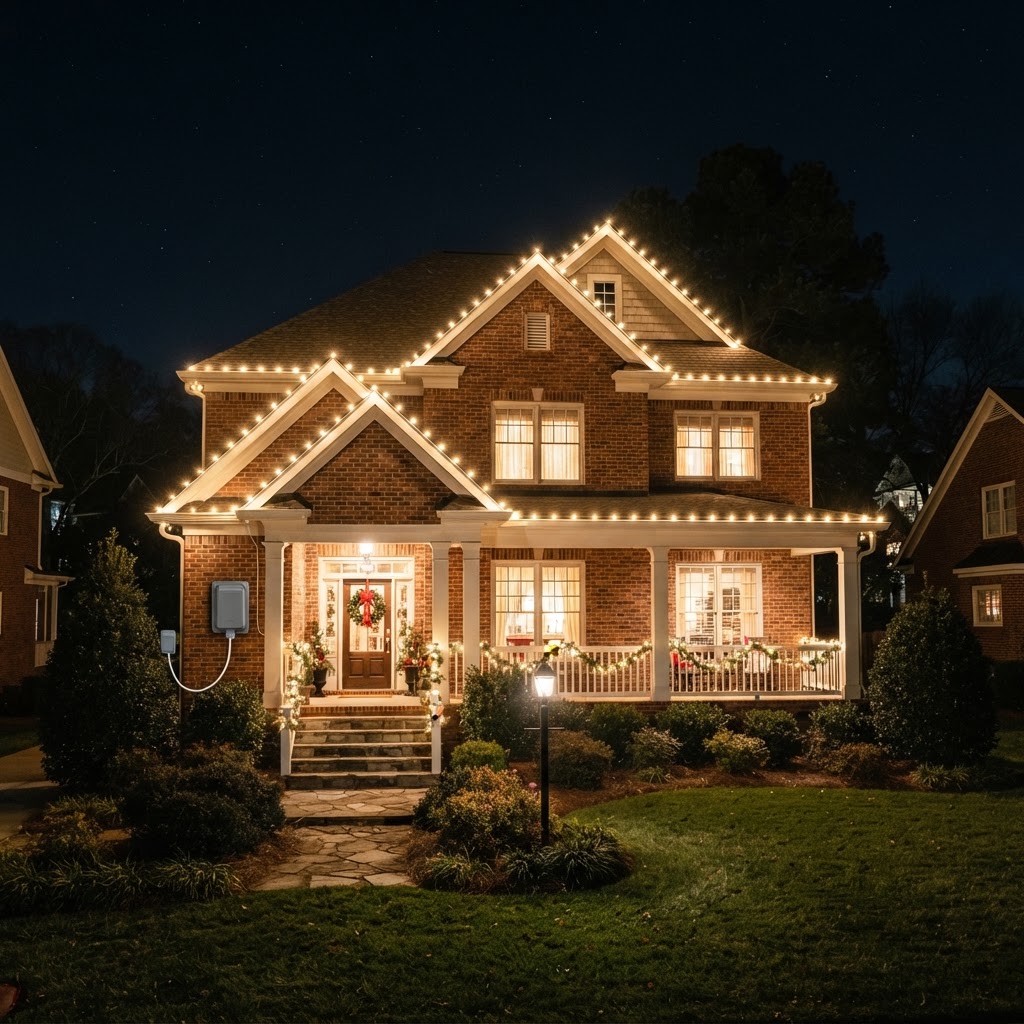
If you're running extension cords through windows, across lawns, or around doors to power your holiday display, the right solution is to have outdoor outlets installed. Adding a weatherproof GFCI outdoor outlet typically costs $150–$350 and takes a few hours. You'll eliminate extension cord hazards and have convenient power for outdoor lighting, tools, and entertaining year-round.
Timer Controls for Holiday Lighting
Use a timer to control your holiday lights automatically. Options include:
- Outdoor mechanical timers: $10–$20, simple dial operation
- Smart plug timers: $15–$30, WiFi-connected, controlled from your phone with scheduling and sunrise/sunset automation
- Photocell timers: Turn lights on at dusk and off at a set time — no programming needed
Timers save energy, prevent lights from being left on accidentally, and reduce wear on your lighting by limiting operating hours.
Free Safety Inspection Before the Holidays
Dausman Electric offers free electrical safety inspections for new customers throughout Winston-Salem, Forsyth County, and the Triad. We'll check your outdoor outlets, GFCI protection, panel capacity, and any potential hazards before you hang your holiday lights.
Call (336) 978-7844 or schedule online.
See also: GFCI Outlets Guide | Circuit Breaker Guide | Whole-Home Surge Protection